
The Gallbladder
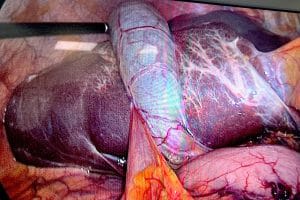
The gallbladder is attached to the liver. It drains into the bile duct which itself then drains into the duodenum.
The gallbladder is a small, pear-shaped organ tucked just under the liver. The liver makes about 500ml of bile per day and this is stored within the gallbladder.
The arrival of food in the stomach leads to the gallbladder squeezing its bile along the bile ducts and into the duodenum. At this point the bile helps to digest fats that have been ingested and facilitate the absorption of fat soluble vitamins (A, D, E and K).
Gallstones
When there is an imbalance in the constituent parts of bile (cholesterol, calcium, bilirubin, water) gallstones may form. These may be as small as sand/sludge or as large as pebbles, sometimes filling the gallbladder. They may take months or years to grow.
Gallstones can run in families, they are more common in women than in men, and approximately 20% of the adult population has gallstones.
Gallstone symptoms
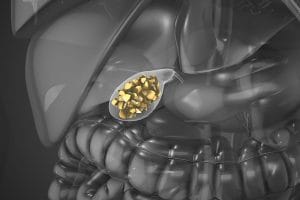
Gallstones illustration.
Of the 20% of the adult population who have gallstones, approximately 20% will have symptoms. Therefore 80% of gallstones are asymptomatic and often incidental findings. If gallstones do become symptomatic, then they can cause a number of different problems:
Biliary colic (pain)
Contraction of the muscles of the gallbladder against stones/sludge can cause severe upper abdominal pain. This pain can last for quite a few hours before it settles down. You may not experience another similarly intense attack for days or weeks, but at some point it is highly likely that the severe pain will recur. Often this type of pain is caused by certain foods (typically fatty foods).
Cholecystitis
If there is an infection/inflammation, as well as pain, then the diagnosis is likely to be cholecystitis. You may feel generally unwell with associated fevers and be particularly sore when moving around.
Gallstone pancreatitis
Sometimes a gallstone may get stuck at the lower end of the bile duct and cause a temporary blockage of the pancreatic duct, leading to inflammation of the pancreas. This manifests itself as severe abdominal pain and often requires emergency admission to hospital until it settles down. Once settled, the gallbladder should be removed as soon as possible to prevent further episodes of acute pancreatitis. Severe acute gallstone pancreatitis can be a very serious condition.
Jaundice/Cholangitis
A gallstone in the common bile duct can also cause a blockage. This may manifest itself as jaundice and you may notice a yellow tinge to the skin as well as pale stools and dark urine. If the jaundice becomes associated with an infection (cholangitis) then urgent hospital admission is required.
Gallbladder polyps
Polyps of the gallbladder are often discovered as an incidental ultrasound finding. A polyp is an outgrowth of tissue on the inside wall of the gallbladder and true polyps do not cause symptoms. However there is a very small cancer risk associated with gallbladder polyps and so generally it is prudent to keep an eye on the polyps, or even remove the gallbladder entirely.
Biliary dyskinesia
When patients present with pain suggestive of gallstones but an ultrasound scan shows a normal looking gallbladder we consider a diagnosis of biliary dyskinesia. This means that the gallbladder does not contract to the normal signals and can cause pain. This is a difficult diagnosis to prove.
Book a free consultation
For insured, self-funded or NHS enquiries, please complete the enquiry form. We will be back in touch as soon as possible.
- Avoid the NHS waiting list
- Reply to enquiry within 24 hours
- Day case surgery
- Self-pay (including payment plans)
- Insured